Playbooks and plan edge
Write your setups as rules and see what following them is worth.
A playbook is one of your setups written down as a short list of rules. When you review a trade, you tick the rules you actually followed. Crux then splits your results between trades that kept to plan and trades that didn’t.
Create a playbook
- Open Playbook and create a new playbook. Name it after the setup, for example Opening range break.
- Add its rules, one per line — things you can answer yes or no, like Waited for the candle close or Size at plan.
- Save. You can reword, reorder or remove rules later, or remove the playbook entirely.
Score a trade
- Open a trade and set its setup to the playbook.
- Tick each rule you followed, and leave the ones you broke unticked.
What is plan edge?
- Plan edge is your average P&L on trades that followed the plan minus your average on trades that didn’t. It shows up on the Playbook page, the Dashboard and Analytics.
- Crux also shows which rule costs you the most when you break it.
- A trade you haven’t scored yet counts as unreviewed, never as a broken rule, so imported trades don’t drag your numbers down before you get to them.
- Editing a playbook never rewrites trades you’ve already scored. Changing a trade’s setup clears its old score, because it was scored against different rules.
Playbooks are part of the Edge and Elite plans.
What makes a good rule?
One you can answer yes or no about after the trade, without arguing with yourself. “Waited for the 5-minute candle to close above the range” works. “Traded well” doesn’t. Most setups need three to six rules; more than that and scoring becomes a chore you skip, which helps nobody.
An example of plan edge
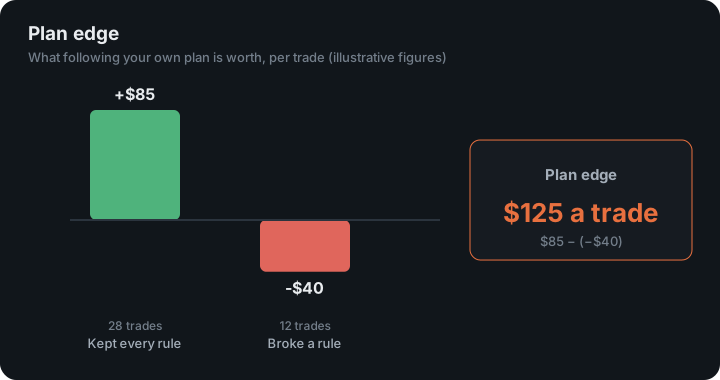
Say your Opening range break playbook has 40 scored trades: 28 that kept every rule and averaged +$85, and 12 that broke at least one and averaged −$40. Plan edge is the difference: $125 a trade. In plain words, following your own plan has been worth $125 a trade to you. If the number is small or negative, the plan itself may need work, which is just as useful to know.
Figures in the example are illustrative, to show the arithmetic. Your own come from your account.
Which rule costs the most?
For each rule, Crux compares trades where you broke it with trades where you kept it, and names the one with the biggest gap. That is the rule to watch first. A rule that is always kept, or always broken, has nothing to compare and isn’t named.
Rewording a rule
Each rule keeps its identity when you reword it, so its history follows. Trades already scored keep the snapshot of the rules as they were, which means editing a playbook today never rewrites what you decided about last month’s trades. Crux’s export carries each trade’s scores with the rule wording, so a journal moved to another account keeps them.
Scoring many trades at once
Bulk edits on the Trades page can set the setup and tags for many trades, but
never their scores. Whether a trade kept its rules is a judgement about that trade, so it is made one
trade at a time. In a spreadsheet, the scores look like this: Waited for the close=y | Size at
plan=n. That is how Crux’s export carries them, and how an import reads them back.
Set a monthly goal for “plan followed” and Crux tracks the share of scored trades that kept their playbook through the month.
An example: the rule that costs the most
Your playbook has three rules. Trades that broke “Size at plan” averaged −$95 against +$40 when you kept it, a gap of $135. “Waited for the close” shows a gap of $60, and “Stop placed before entry” one of $20. Crux names “Size at plan” as the rule to watch first. The figures are illustrative.
One playbook per setup keeps the numbers clean. A playbook that covers three different ideas averages them together and hides which one works.
Where to look: the Playbook page shows each playbook’s on-plan and off-plan averages and its plan edge; the dashboard card shows your plan edge across every playbook; and Analytics splits your results by setup. Each trade has one setup at a time, so it is scored against one playbook.
Writing a rule down before the trade has research behind it. Studies of implementation intentions, plans of the form “when this happens, I will do that”, found they make people more likely to follow through (Gollwitzer, 1999). Crux’s export is a plain CSV file of the kind described in RFC 4180, so any spreadsheet can open it.
Keep reading
- Importing files — Bring in a CSV or MetaTrader statement from any broker.
- Habits — Patterns in how you trade after wins and losses, straight from your fills.
- Prop firm evaluations — Track drawdown, daily loss, profit target and consistency against your own trades.