Daily check-in
Rate your sleep, energy, focus and stress before you trade, and see what your state costs.
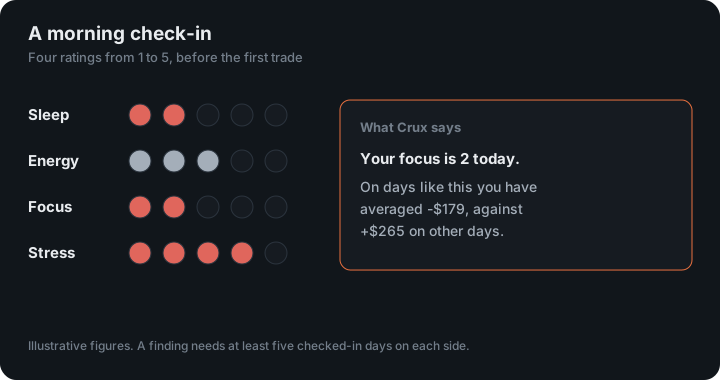
Before the session, the Dashboard asks how you are: sleep, energy, focus and stress, each from 1 to 5, plus a line of your own if you want one. It takes about ten seconds.
On its own that is a diary. Joined to the results of each day it answers a question most traders never get an honest answer to: what is my state costing me? Under Habits, the “Your state and your results” section shows your average day by how you rated yourself, and names what stands out — for example, “on days you rated your focus 2 or lower you averaged −$179 a day, against $265 on other days”. It also notices when you take more trades on your worst days.
The nudge
Because the check-in happens before you trade, a low rating on something that has cost you money before comes straight back as a note the moment you check in, while you can still do something about it. At most two, so it stays worth reading.
Why does stress score the other way?
For sleep, energy and focus, 5 is good. For stress, 5 is bad. Crux reads them that way when it looks for findings.
What does a finding look like?
A sentence with both sides of the comparison. For example: “On days you rated your sleep 2 or lower you averaged −$120 a day, against +$95 on other days (6 and 22 days).” Each rating is compared on its own, so sleep, energy, focus and stress each get their own answer. The figures are illustrative; yours come from your check-ins and trades.
How many check-ins does it need?
At least five checked-in trading days on each side of a comparison before anything is said. In practice that is two or three weeks of checking in most days. Days you don’t check in are left out of the comparison rather than guessed.
What does the nudge say?
Only something your own history backs up. If low focus has cost you before and you rate your focus low this morning, the note says so with the number. If you rate a dimension low that has never made a difference, you hear nothing about it. At most two notes, so they stay worth reading.
Who sees it?
Only you. Check-ins are part of your journal, included in your backups, and never on your public page or a share image.
When should I check in?
Before your first trade of the day, when the question “how am I?” can still change what you do. A check-in after the session still counts towards your findings, but it can’t warn you in time. If you trade on a day you didn’t check in, that day is simply left out of the comparisons.
The line of your own is for anything the four ratings miss, such as a late night or a hard conversation. It isn’t analysed; it is there for you to read back when a day went badly.
What do the ratings mean?
1 is the worst version of that thing and 5 the best, except stress, where 5 is the most stressed. Rate it the way you feel, not the way you think a trader should feel: the findings only work if the ratings are honest. A nudge might read: “Your focus is 2 today. On days like this you have averaged −$179.” The figure is illustrative.
Why these four? Too little sleep makes it harder to focus and react, as the National Heart, Lung, and Blood Institute describes, and the American Psychological Association sets out how stress affects the mind as well as the body. Crux doesn’t assume either effect for you: it measures what your own ratings have meant for your own results.
Keep reading
- Account balance and scaling plan — Your real balance, and the number you want to reach before you trade bigger.
- Sharing your stats — Turn a week, a month or your plan edge into an image to post.
- Risk rules, what-if and goals — Your own rulebook checked on every trade, a simulator to test a rule first, and monthly goals.