What a consistency rule is
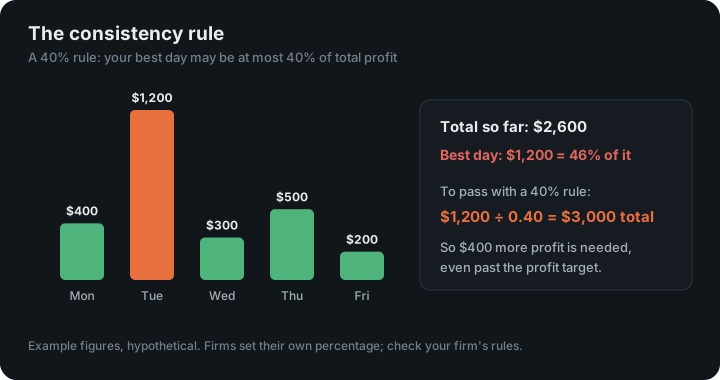
Prop firms want to pay traders whose profit comes from many days, not one lucky session. A consistency rule measures that with one number:
consistency % = best day’s profit ÷ total profit
If that number is above the firm’s limit, you are not finished yet. Turn the formula round and it tells you how far you have to go:
total profit needed = best day ÷ the firm’s percentage
A worked example
Four days on an evaluation: $400, $600 and $500, then everything clicks and day four makes $1,500. Total profit is $3,000 and the best day is $1,500, so the best day is 50% of the total.
| Firm’s limit | Best day is | Total needed | Still to make |
|---|---|---|---|
| 55% | 50%: inside | $1,500 ÷ 0.55 = $2,727 | $0: already at $3,000 |
| 40% | 50%: over | $1,500 ÷ 0.40 = $3,750 | $750 |
Worked sums with round numbers to show the mechanics. Not a trading result or advice.
Under a 40% rule, the trader who just had the best day of the evaluation still owes $750, and it has to come on days smaller than $1,500. Make another $1,500 day and the best day is unchanged but the total jumps, so that would work too; make a $2,000 day and the bar moves up again, to $5,000.
Why a losing day makes it worse
A loss lowers your total profit, but your best day stays your best day. Topstep’s help centre says it directly: “Losses do not reset your best day.”
Back to the example under a 40% rule. Day five loses $500. The total drops to $2,500, the best day is still $1,500, and you still need a total of $3,750. What you owe has grown from $750 to $1,250.
How Topstep and Lucid apply it
Firms differ on the percentage, on when the rule applies, and on what happens when you are over it. Two examples, from their own help centres:
| Account | Limit | If you are over it |
|---|---|---|
| Topstep Trading Combine | 55% | Your profit target rises |
| Topstep Express Funded Account (consistency path) | 40% | Not payout eligible until it falls |
| LucidFlex evaluation | 40%, or 50% with an add-on | Keep trading until your largest day is within it |
| LucidFlex funded | None | – |
Topstep. On the Trading Combine, Topstep calls 55% “a hard line. It is not rounded, and there is no buffer.” Its own example: a $1,800 best day needs $1,800 ÷ 0.55 = $3,273 of total profit; if the next day makes $2,200, that becomes the best day and the target becomes $4,000. A day’s value locks at 3:10 PM CT, and extra profit made the same day only raises that best day, so the rest has to come on a later day. One wording point: the rule text says 55% “of your Profit Target”, while its formula and examples divide by total profit. The examples are the ones to plan with.
On the Express Funded Account consistency path, the best day must be 40% or less of total net profit to request a payout, with at least three trading days. Topstep’s example is $3,600 out of $9,500, or 37.9%. After a payout the count starts again from zero.
Lucid. A LucidFlex evaluation uses 40%, or 50% if you choose that at checkout. Lucid describes the 50% option as including “a small cushion” worked out from your actual daily profit. Once funded, LucidFlex has no consistency percentage at all.
Other firms use other numbers, and some apply the rule only to payouts. The LucidFlex daily loss limit guide and the trailing drawdown guide cover the rules that end accounts; this one usually only delays them.
The most you can make today and stay inside
If today could become your best day, there is a ceiling on it. With a limit of p and total profit so far of T:
today’s ceiling = p × T ÷ (1 − p)
In the example, before day four the total was $1,500. At 40%, the ceiling was 0.40 × $1,500 ÷ 0.60 = $1,000. A $1,000 day makes $1,000 out of $2,500: exactly 40%. The $1,500 day went past it, which is why there was more to make. This is not a reason to close good trades early; it is a number to know before the session, so a big day does not surprise you at payout time.
Before a payout or the last day of an evaluation
- Find your best day and your total profit on the firm’s dashboard, for the right window.
- Divide one by the other. Over the limit? Work out the total you need: best day ÷ percentage.
- Plan the rest on days below your best one, and remember a losing day adds to what you owe.
- Check whether your account has the rule at all; some funded accounts do not.
Tracking it in Crux
Crux is a trading journal. It reads your fills; it never places a trade. Here is what it does with an evaluation account:
- Evaluation tracks the account against its rules, including the consistency rule, beside the drawdown floor, daily loss limit and profit target. Start from a preset or choose Custom, then check every number against your account. How evaluations work.
- It works from your fills, and firms count days and lock times their own way, so your firm’s dashboard is the final number.
Evaluations are on the Elite plan and in every free trial. To check an account without connecting anything, the free prop firm calculator works out what the profit target and the consistency rule still need from numbers you type in.
Questions
What is a consistency rule?
A cap on how much of your total profit can come from your single best day. Your best day divided by your total profit has to stay at or under the firm's percentage before you pass or get paid.
How do I calculate my consistency percentage?
Divide your best day's profit by your total profit. A $1,500 best day out of $3,000 total is 50%. To find the total you need, divide your best day by the firm's percentage: $1,500 at 40% needs $3,750.
Does breaking the consistency rule fail the account?
At Topstep and on a LucidFlex evaluation, no. Topstep raises your profit target, and Lucid has you keep trading until your largest day is back within the limit. Either way you need more profit, on days smaller than your best one.
Do losing days count?
They lower your total profit but not your best day, so a losing day pushes your percentage up. Topstep says it plainly: losses do not reset your best day.
What are Topstep's and LucidFlex's consistency limits?
Checked on 19 October 2026: Topstep's Trading Combine uses 55% and its Express Funded Account consistency path 40% for payouts. A LucidFlex evaluation uses 40%, or 50% with an add-on, and LucidFlex funded accounts have no consistency rule. Check your own dashboard.
Sources: Topstep: Consistency at Topstep, Lucid Trading: LucidFlex Consistency Percentage, Lucid Trading: LucidFlex Evaluation Account, Lucid Trading: LucidFlex Funded Account, read on 19 October 2026. Topstep and Lucid Trading are trademarks of their owners; Crux is not affiliated with either. Seen something out of date? Email support@cruxjournal.com and we will fix it.